

Workplace
The Workplace is the page every user signs in to. It has two sections, Applications and AI Workspace, chosen from the menu on the left. Next to Applications, a panel on the right shows the devices the Netzilo client on this computer can see, or this browser's private access. Users need no technical knowledge to use it: they sign in and open what is there.
Regular users land on the Workplace. Administrators open it by clicking the company logo in
the top-left corner of the dashboard, and return with Dashboard in the Workplace menu.
The address is https://go.netzilo.com/workplace on Netzilo Cloud, or
https://<your-domain>/workplace on a self-hosted server. The same Workplace also opens in
the Netzilo desktop app and in the Netzilo browser extension, see
Where the Workplace opens.
An administrator can turn the Workplace off for regular users under Settings > Permissions with Disable portal access for regular users. Regular users are then sent to the install page instead. Administrators always reach the Workplace.
How it works
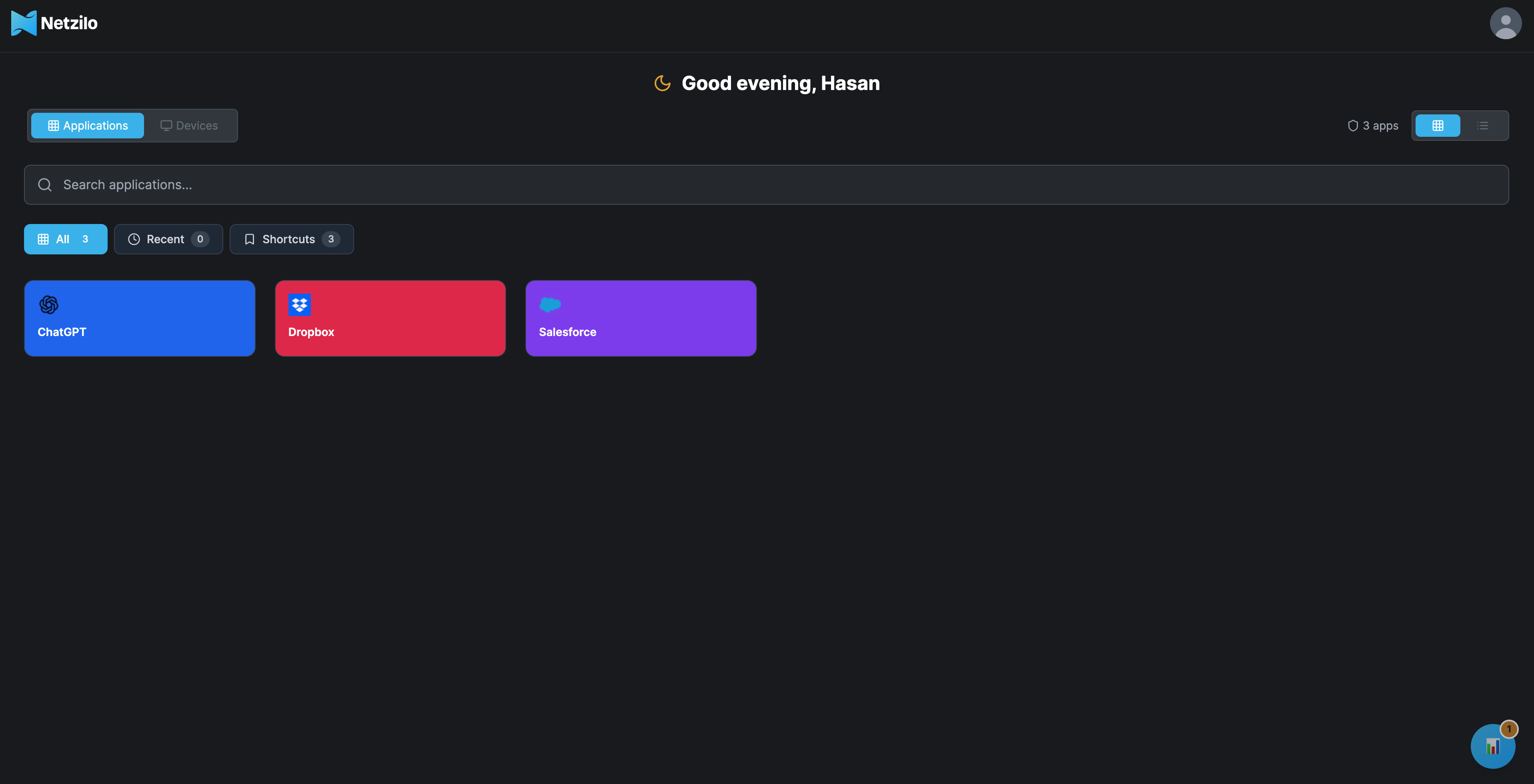
The page has three parts:
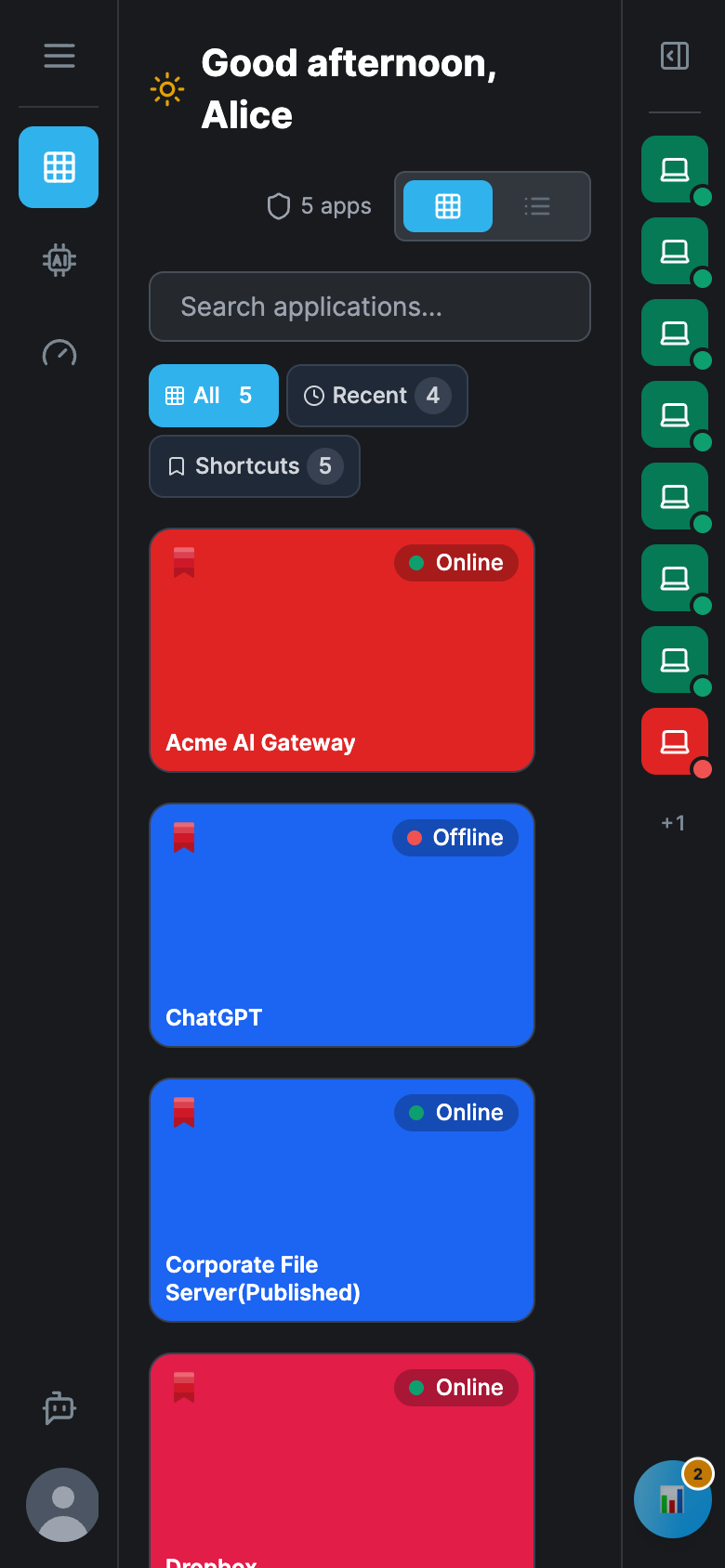
- The menu on the left switches between the sections and holds the AI Assistant and your user menu. See The menu.
- The section in the middle: Applications, or the AI Workspace when an AI gateway or MCP server is granted to you.
- The panel on the right belongs to the section. Next to Applications it shows your devices and this browser's private access. Next to the AI Workspace it shows your AI gateways and MCP servers, see Agentic Access.
A collapsed panel keeps a narrow strip with one mark per item and its status. Click the expand button at the top of the strip, or any mark, to open it; the button at the top of the open panel collapses it again. The browser remembers whether each panel is open, and which section you used last.
Where the Workplace opens
The Workplace is one page, shown in three places:
| Place | How users get there |
|---|---|
| The dashboard | https://go.netzilo.com/workplace on Netzilo Cloud, https://<your-domain>/workplace self-hosted. Regular users land on it after sign-in. |
| The Netzilo desktop app | The app's window on Windows, macOS and Linux. It opens when the app starts; Open... in the tray menu opens it again. |
| The Netzilo browser extension | The Workplace button (grid icon) at the top of the extension's popup opens the extension's Workplace page in a new tab. In the Netzilo Enterprise Browser, that page is the new tab. |
What differs between them:
| Dashboard | Desktop app | Extension and Enterprise Browser | |
|---|---|---|---|
| Signed out | The dashboard's sign-in | The workplace picker | The workplace picker |
| Sign-in | The dashboard's sign-in | The Netzilo client's sign-in on this computer: no second sign-in | The extension's sign-in to the workplace |
| Onboarding Progress | Shown | Not shown | Not shown |
| Dashboard in the menu | Owners and admins | Owners and admins | Owners and admins |
The desktop app starts with its window open. On Windows, the app that starts at sign-in stays in the tray until the user opens it. Closing the window keeps the app in the tray. On macOS the app shows a Dock icon while its window is open; clicking the Dock icon reopens the window.
Pick a workplace
Signed out, the desktop app and the extension's Workplace page show the workplace picker: Welcome Back! and Pick a workplace and press "Connect" to continue.
- Default Workplace is always first and cannot be forgotten. The workplaces the user added follow, the one used last first. Each row shows the workplace's name and address.
- Connect on a row starts the sign-in. The page shows Redirecting..., Taking you to your identity provider for authentication., with Cancel, and the browser opens the identity provider. After the sign-in the Workplace opens.
- ⋮ > Forget workplace on an added row removes it from the list.
- Add Workplace, below or define a new workplace, opens Add a workplace. Enter the address and click Next. The workplace is checked and added to the list.
The name in each row comes from the workplace itself; on a self-hosted server the administrator sets it, see Server reference. A workplace without a name shows its address.
| Message | Meaning |
|---|---|
| Enter a valid https address. | The address is not an https:// address. |
| This address is not a Netzilo workplace. | Nothing at that address answers as a Netzilo Server. Check the address and that this computer reaches it. |
| Sign-in did not complete. | The sign-in was cancelled, failed or timed out. Click Connect again. |
In the desktop app
- Default Workplace is the server the device was set up for: the
NETZILOSRVvalue of the deployment, else the management server the client service uses, else Netzilo Cloud. - Add a workplace asks for the Management server URL, for example
https://srv.your-company.com. The app accepts it once the server's API answers. - Connect signs the Netzilo client on this computer in to that server and connects it. The window then shows that server's Workplace, signed in with the client's own sign-in.
- The list is kept per user in
Netzilo/workplaces.jsonin the user's configuration folder:~/Library/Application Support/Netzilo/workplaces.jsonon macOS,%AppData%\Netzilo\workplaces.jsonon Windows,~/.config/Netzilo/workplaces.jsonon Linux.
In the browser extension and the Enterprise Browser
- Add a workplace asks for the Workplace URL, for example
https://your-workspace.netzilo.com. The extension readshttps://<address>/.well-known/netzilo.jsonand accepts the address only when it is a Netzilo Server served over HTTPS. - Connect opens the sign-in in the same tab.
- When your organization manages the extension's server setting (
activePortalwithlockPortal, see Several servers), the picker shows only that workplace, with no Add Workplace and no Forget workplace. - In the Enterprise Browser, Default Workplace is the tenant set at install (
TENANTor--netzilo-tenant, see Installer command lines), and the browser keeps its own list. A browser installed locked to its tenant (FORCETENANT=1or--netzilo-forcetenant) lists only the tenant, with Connect, also after a logout. There is no Add Workplace and no Forget workplace, and a sign-in elsewhere is refused. See Lock the browser to your Workplace. While it signs in or out, the new tab shows Logging in... or Logging out... with Cancel. Current versions stay signed in when the connection to the browser's built-in client drops, for example after sleep, and reconnect with the stored sign-in.
The menu
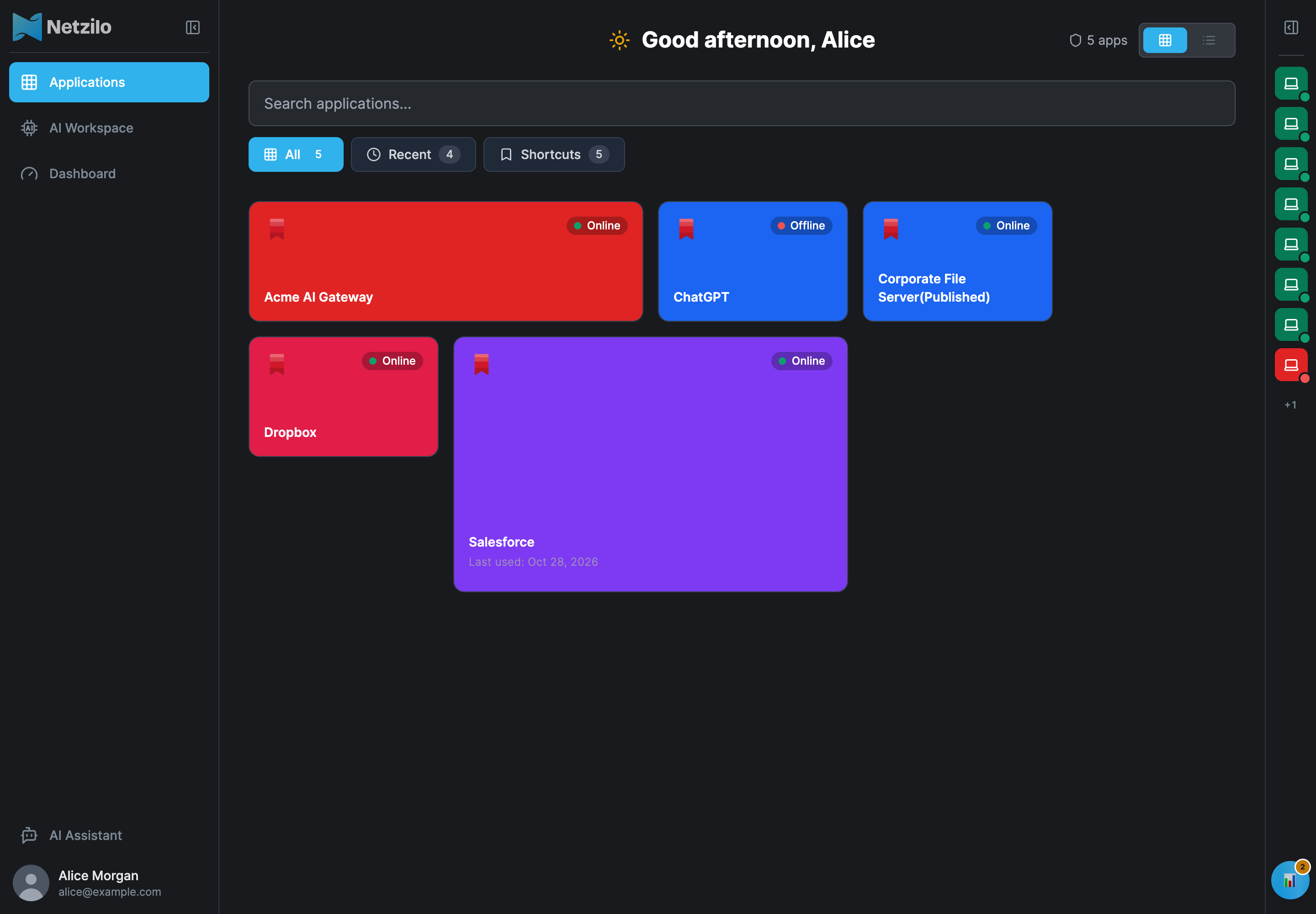
The menu shows icons only. Click the menu button at its top to expand it with labels and the company logo; the button next to the logo collapses it. Hover over an icon of the collapsed menu to see its name.
| Item | What it does |
|---|---|
| Applications | The applications you may open, see Applications |
| AI Workspace | A chat with the AI models and MCP tools granted to you, see AI Workspace. It appears only when an enabled gateway filter grants you at least one AI gateway address or one MCP server. |
| Dashboard | Back to the dashboard. Shown to owners and admins only, in every place the Workplace opens. |
| AI Assistant | The Netzilo AI Assistant, see AI Assistant |
| Your picture | The user menu: Profile Settings, Display Status and sign out. The expanded menu shows your name and email address next to it. |
Applications
The Applications section collects three kinds of tiles:
- Bookmarks from the Netzilo browser extension profiles that apply to you. When you open the Workplace in the Netzilo Enterprise Browser, its bookmarks are added too. See Profiles.
- Published applications you may open. A tile opens the application at its own address in a new tab, in any browser. See Published Applications.
- Shortcuts that the Netzilo client on this computer provides, such as the applications of a Netzilo Enterprise Workspace.
The counter next to the greeting shows how many applications you have. The two buttons next to it switch between tiles and a list; the browser remembers your choice. The search box filters by name and address.
The filters above the tiles narrow the list. The page opens on All every time.
| Filter | Shows |
|---|---|
| All | Every tile |
| Recent | The five applications you opened last in this browser |
| Shortcuts | The web tiles: bookmarks and published applications |
| One filter per profile | The client shortcuts that profile provides, when the Netzilo client has any |
Tile sizes
Tiles keep a fixed size and the grid places as many as fit in a row. The applications you use most get bigger tiles: an application opened more than 5 times in this browser takes two places side by side, and one opened more than 10 times takes a square of four, with the date you last used it. On a phone every tile takes one place.
Online and Offline
Each web tile shows whether the application answers right now:
| Pill | Meaning |
|---|---|
| Online | The application answered this browser. Any answer counts, a sign-in page or an access-denied page included. |
| Offline | The application did not answer within 8 seconds. |
| No pill | The status cannot be checked from the page: the application's address starts with http://, or the tile is a client shortcut. |
The browser checks the applications when the page opens and again every minute while the page is on screen. The check is a request without your cookies or sign-in, so it changes nothing in the application. It reaches the application the way this browser does: an application reached through Netzilo shows Online only while this computer's Netzilo client or this browser's private access is connected.
Pages served over https://, such as the Workplace, are not allowed by the browser to send
requests to http:// addresses. Such applications open normally from their tile, but show
no status. Serve the application over HTTPS, or publish it as a
published application, to get a status.
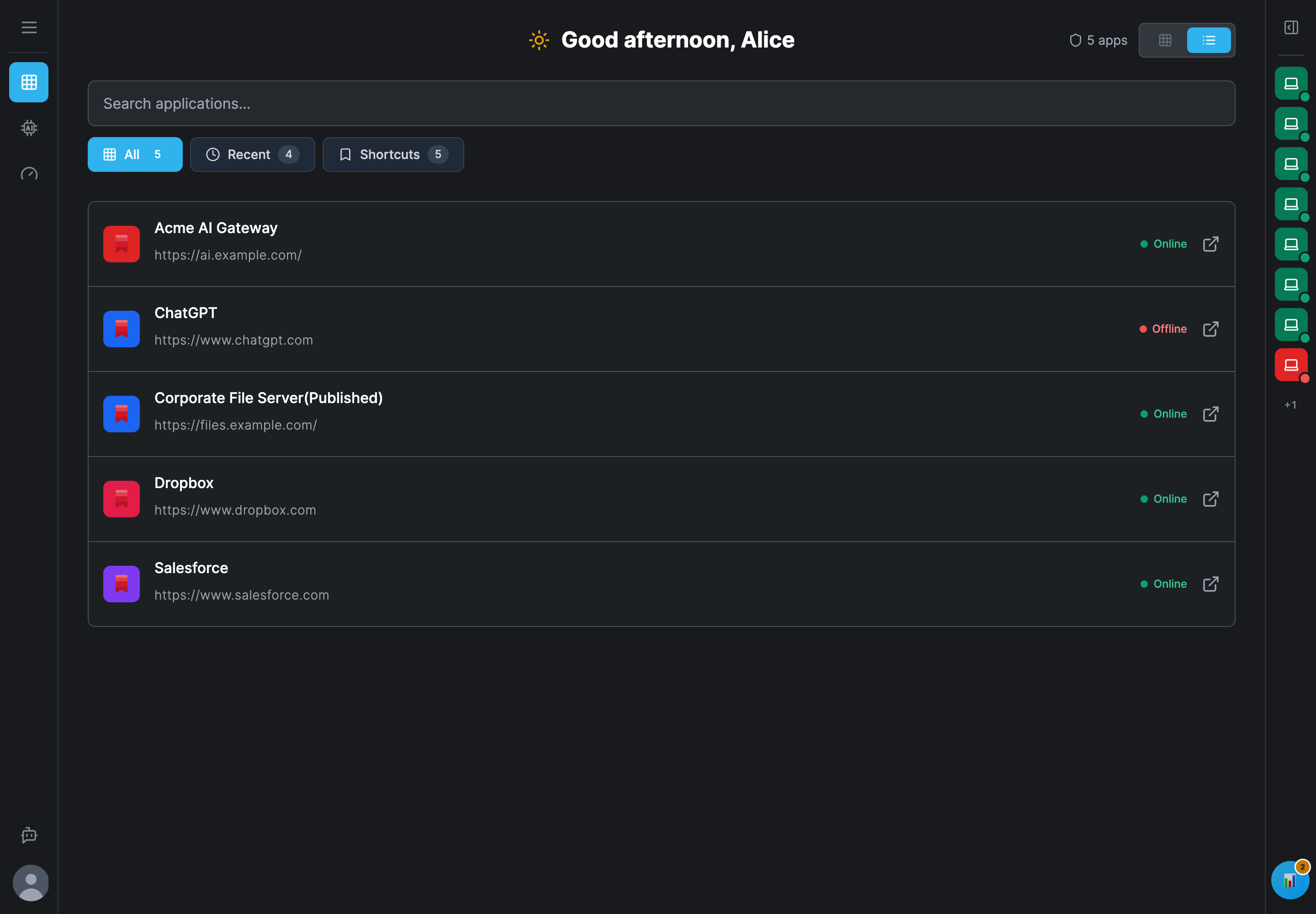
The list view shows each application's address next to its status:
Devices
The Devices panel lists the peers that the Netzilo client on this computer can see: your own devices and the ones your policies let you reach. It reads them from the local client, so it shows only what this computer's client reports.
Only your own client counts. The Workplace shows this computer's devices, and the client's shortcuts under Applications, only when the Netzilo client on this computer is your own connected device on the same server. It asks the server whether the client's key belongs to you. Otherwise the Workplace treats the client as not signed in and shows no devices and no shortcuts: the client is signed in as another user, was enrolled with a setup key, is connected to another server, or is not connected. The answer is kept for 60 seconds. The desktop app skips this check, because it signs in with the client's own sign-in.
The panel starts collapsed. Its strip shows up to eight devices, online ones first, each with a green (online) or red (offline) dot, and +n for the rest. With no device to show, a single mark says where the search stands: Netzilo client not reachable, Retrieving your devices... or No devices. Click the strip to open the panel:
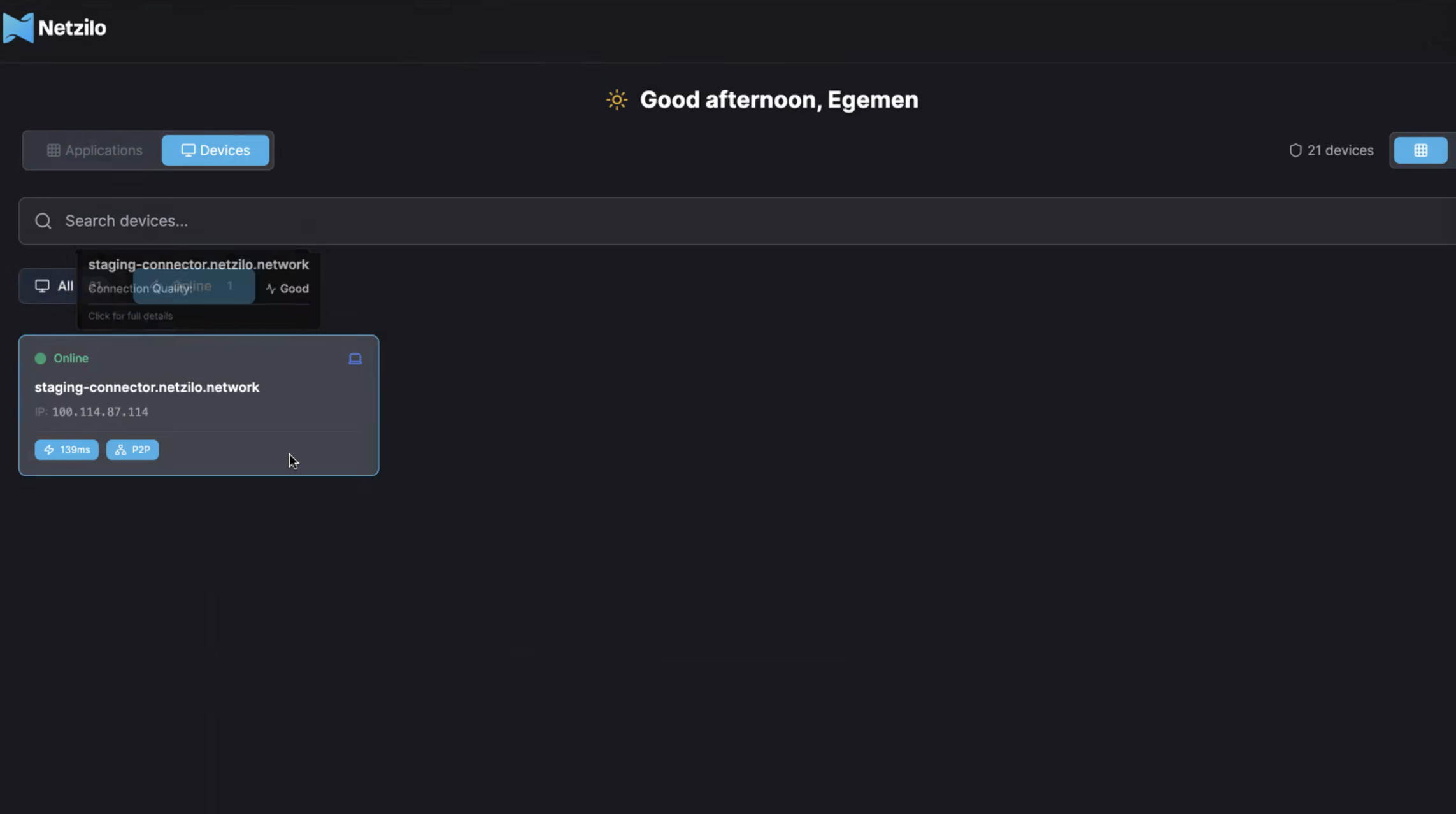
- Search devices... filters by name and address.
- The count next to Devices is the number of devices. From 10,000 it is shortened, for example 12.3K; hover over it for the exact number.
- The dots and online/total next to it show how many devices are online.
- All and Online filter the list.
Each row shows the device's name, its Netzilo IP address, Online or Offline, and for an online device its latency and P2P (a direct connection) or Relayed (the traffic goes through a relay). The IP button copies the IP address; the copy button next to it copies the device's domain name. Long lists load more rows as you scroll.
Click a row to open the device's details:
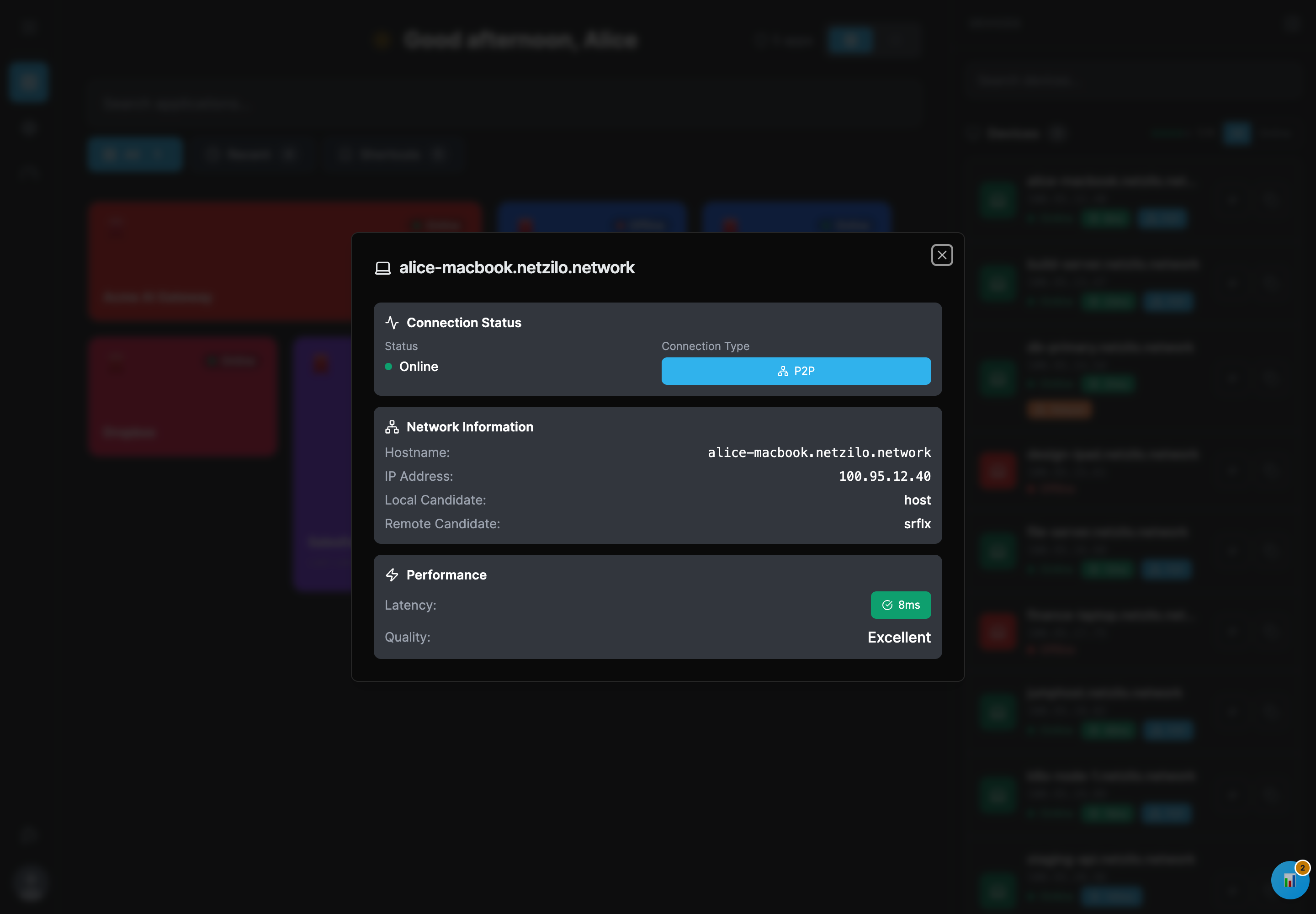
| Section | Fields |
|---|---|
| Connection Status | Status, Connection Type: P2P or Relayed |
| Network Information | Hostname, IP Address, Local Candidate, Remote Candidate |
| Performance | Latency and Quality: Excellent, Good, Fair or Poor |
Right after the page opens, the panel keeps looking for devices for five minutes before it reports that there are none. When the client does not answer, it says Netzilo client not reachable. Start Netzilo on this computer to see your devices.
Private access
A browser with the Netzilo browser extension but no Netzilo client on the computer can reach internal resources through a Netzilo gateway. See Clientless Access. The panel next to Applications then shows a Private access section in place of the devices:
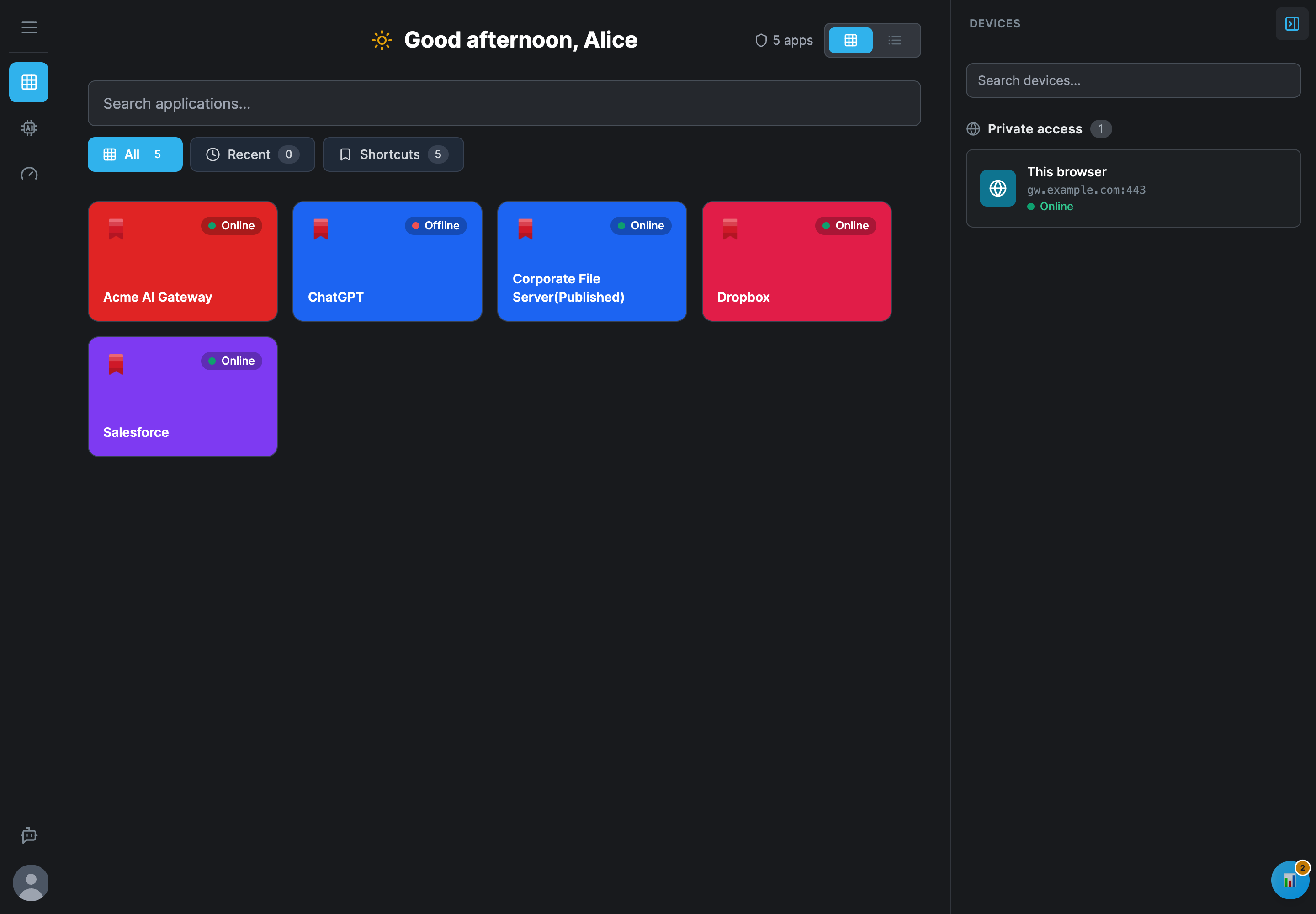
The row This browser names the gateway and the state:
| State | Meaning |
|---|---|
| Online | This browser reaches private resources through the Netzilo gateway. |
| Suspended | Private resources are suspended right now. They will be resumed when needed. The details name the reason the extension reported, when it has one. |
On the collapsed strip, a globe mark with a green (online) or yellow (suspended) dot stands for it. Click the row for the details:
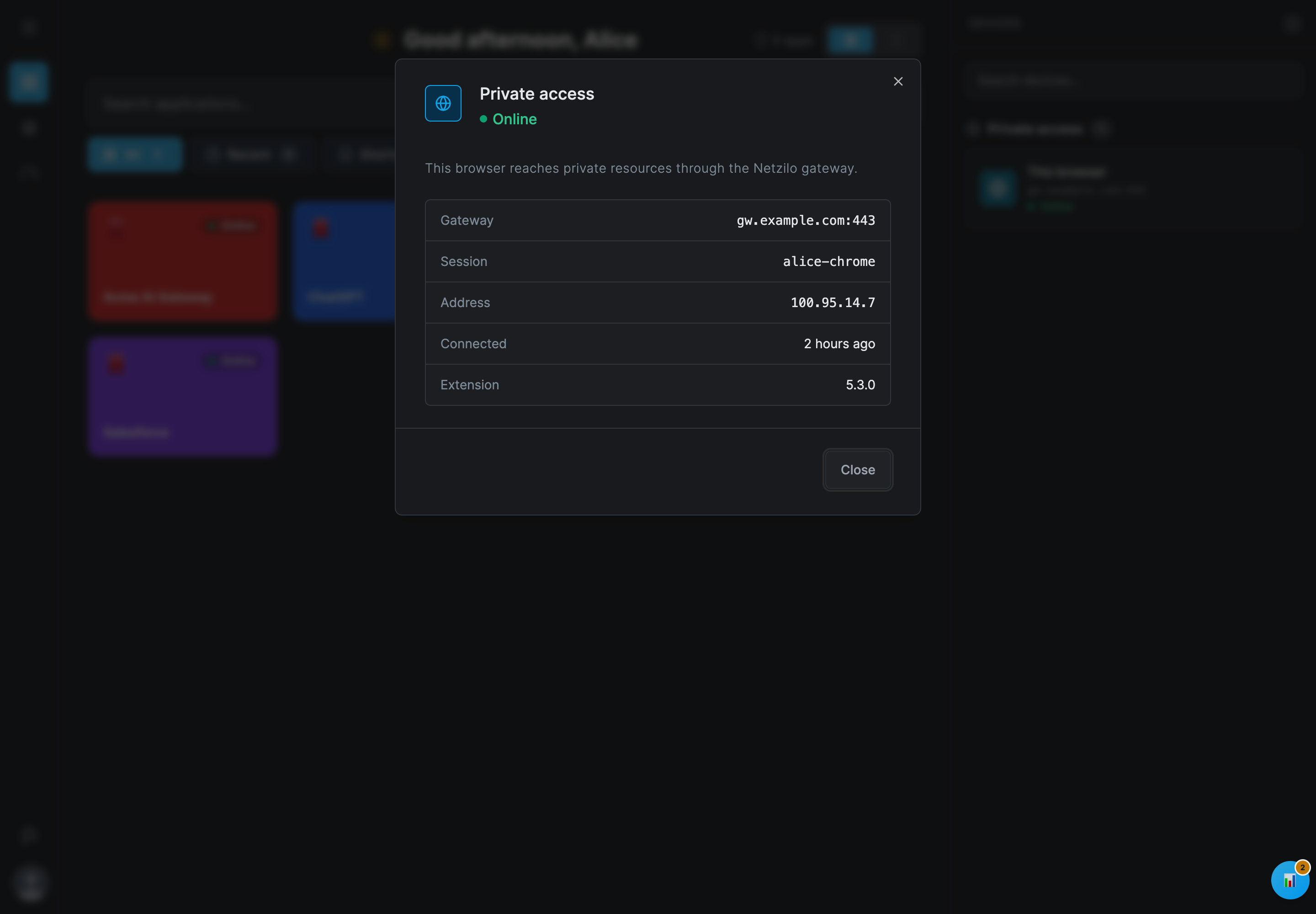
The dialog lists the Gateway, the Session name the gateway gave this browser, its Address, when it Connected, and the Extension version. Everything shown comes from the extension in this browser; nothing is looked up on the server.
When the extension in this browser is not connected to this server, a Netzilo Workplace banner says You are not connected to this server and offers Connect Workplace. When the extension follows another server, the banner names that server. When your organization manages the extension's server setting, the banner says so and the button is not offered.
AI Workspace
When your company grants you an AI gateway or an MCP server, AI Workspace in the menu opens a chat with the models and tools granted to you, next to the panel of your gateways and MCP servers. See AI Workspace for the chat and Agentic Access for connecting your own AI tools.
Onboarding Progress and System Errors
On Windows, macOS and iOS, a round button in the bottom-right corner of the Workplace opens a panel. It appears only on the Workplace in the dashboard, not in the desktop app or the extension's Workplace page. The number on it counts the steps that are still open.
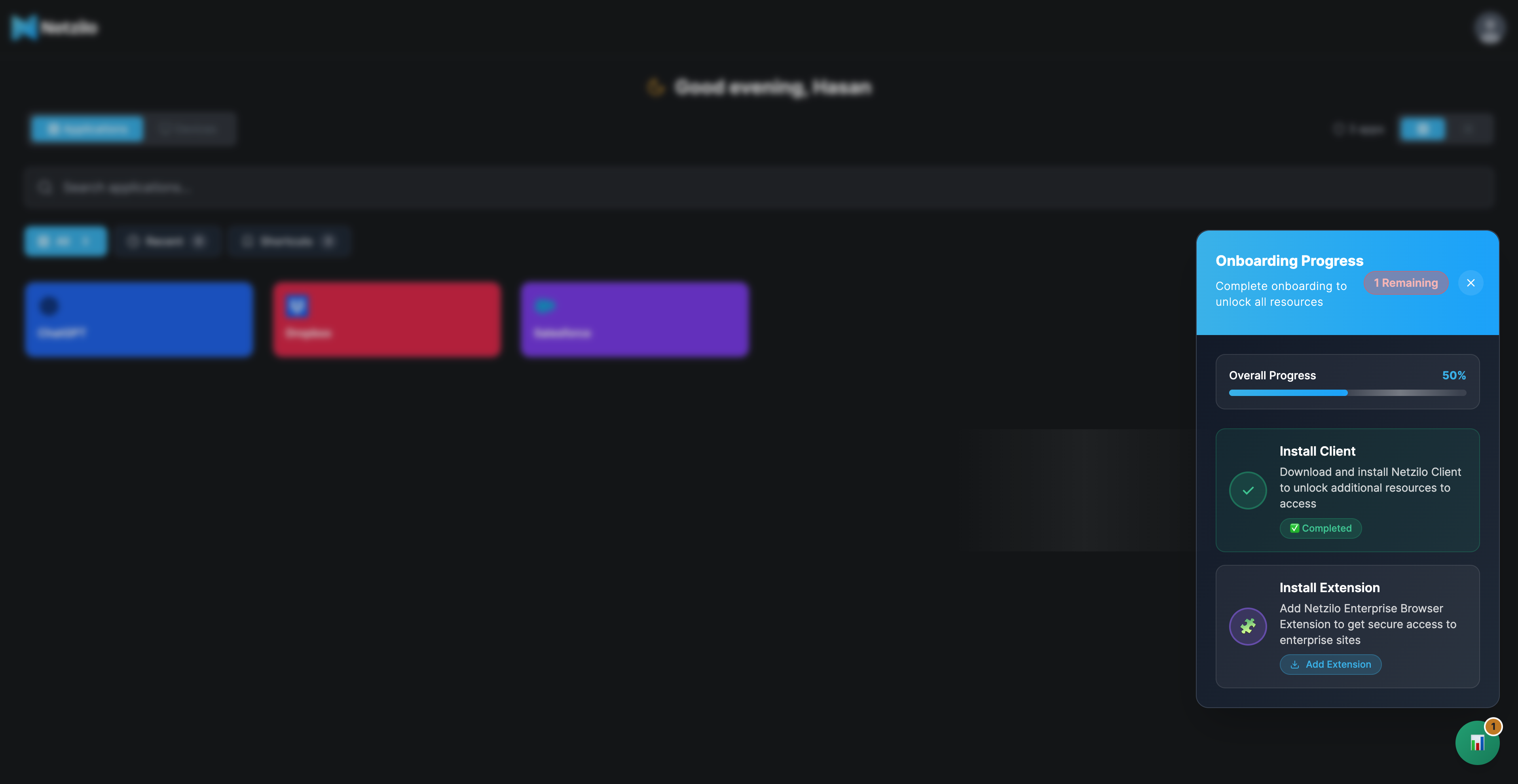
Onboarding Progress lists what is still missing on this device:
- On Windows and macOS: Install Client, with Download Client (on macOS, a choice between Download for Intel and Download for M1 & M2), and Install Extension, with Add Extension. Opening the Workplace in the Netzilo Enterprise Browser completes both steps.
- On iOS: Install Enterprise Browser, with Download App.
System Errors lists the connection problems that the Netzilo client on this computer reports: the Management, Signal, Relay and DNS servers it cannot reach, under a headline such as Critical connection issues detected, Severe service degradation detected or Minor service issues detected. A relay appears only when no relay is reachable at all. System Errors is off by default: turn it on with Display Status in the user menu, which shows that switch only on the Workplace.
AI Assistant
Administrators always have AI Assistant in the menu. Regular users get it when an administrator turns on Allow regular users to use the AI Assistant under Settings > Permissions and the user is in one of the allowed groups. A regular user's assistant works with that user's own permissions and devices. It appears only when a model is approved for the assistant under Integrations > Artificial Intelligence.
Profile Settings
Every user, regular users included, manages their own profile and access tokens from the user menu at the bottom of the menu. See Profile Settings.
On a phone or a small window
The Workplace fits any width. On a narrow window the panel on the right opens over the section instead of beside it; tap outside it, or press Escape, to close it. On a phone the expanded menu opens over the page too and folds again once you pick an item, and every tile takes one place.
The previous Workplace layout, with its header and tabs, stays available at
/my for now.
Troubleshooting
There is no AI Workspace in the menu. No enabled gateway filter grants you a gateway address or an MCP server. Your administrator grants them under Edge > Governance > Filters, see Filters.
The Devices panel says Netzilo client not reachable. No Netzilo client answers on this computer. Start the Netzilo client and reload the page. The panel only ever shows the client of the computer you are using.
The client is connected, but the Devices panel shows no devices and the client's
shortcuts are missing. The client on this computer is not your own device on this server:
it is signed in as another user, enrolled with a setup key, or connected to another server.
Check with netzilo status, then sign the client in as yourself to this server
(netzilo up --management-url https://<your-domain>, or Connect in the desktop app).
After a change, the Workplace asks again within 60 seconds. See Devices.
The picker says This address is not a Netzilo workplace. The address is wrong, is not
a Netzilo Server, or is not reachable from this computer. In the desktop app enter the
management server's address; in the extension and the Enterprise Browser enter the
Workplace address. Both must start with https://.
The picker says Sign-in did not complete. The sign-in at the identity provider was cancelled or failed. Click Connect again and finish it in the browser that opens.
There is no Add Workplace in the extension's picker. Your organization manages the extension's server setting, so only that workplace is offered.
The onboarding button is missing in the desktop app or the Enterprise Browser. Onboarding is shown only on the Workplace in the dashboard.
An application tile is missing. A bookmark comes from a profile that must be enabled and apply to your groups. A published application appears only when publishing is on for the account and one of your groups is admitted to it.
An application shows Offline but opens from another computer. This browser cannot reach it: the application may need this computer's Netzilo client or this browser's private access to be connected, or it may answer only on another address. Open the tile; if the application does not load either, check the connection.
An application has no status. Its address starts with http://, which the browser does
not let the Workplace check, or it is a client shortcut. See
Online and Offline.
A regular user sees the install page instead of the Workplace. Disable portal access for regular users is on under Settings > Permissions.
The bottom-right button is missing. It appears only on Windows, macOS and iOS, and only while an onboarding step is open or Display Status is on with an error to show.
A device shows Relayed or Poor quality. The connection to that device goes through a relay instead of directly. See Troubleshooting client issues.
Related Documentation
- AI Workspace - Chat with the models and MCP tools granted to you
- Agentic Access - Connect AI tools to the gateways granted to you
- Profile Settings - Your own profile and access tokens
- Published Applications - Private web applications at their own address
- Clientless Access - Browser access with only the Netzilo extension
- Profiles - Bookmarks, Enterprise Browser and Workspace settings
- Permissions - Portal access and the AI Assistant for regular users
- CLI - The desktop app's tray menu and the client's command line
- Browser Extension - The extension's popup and sign-in